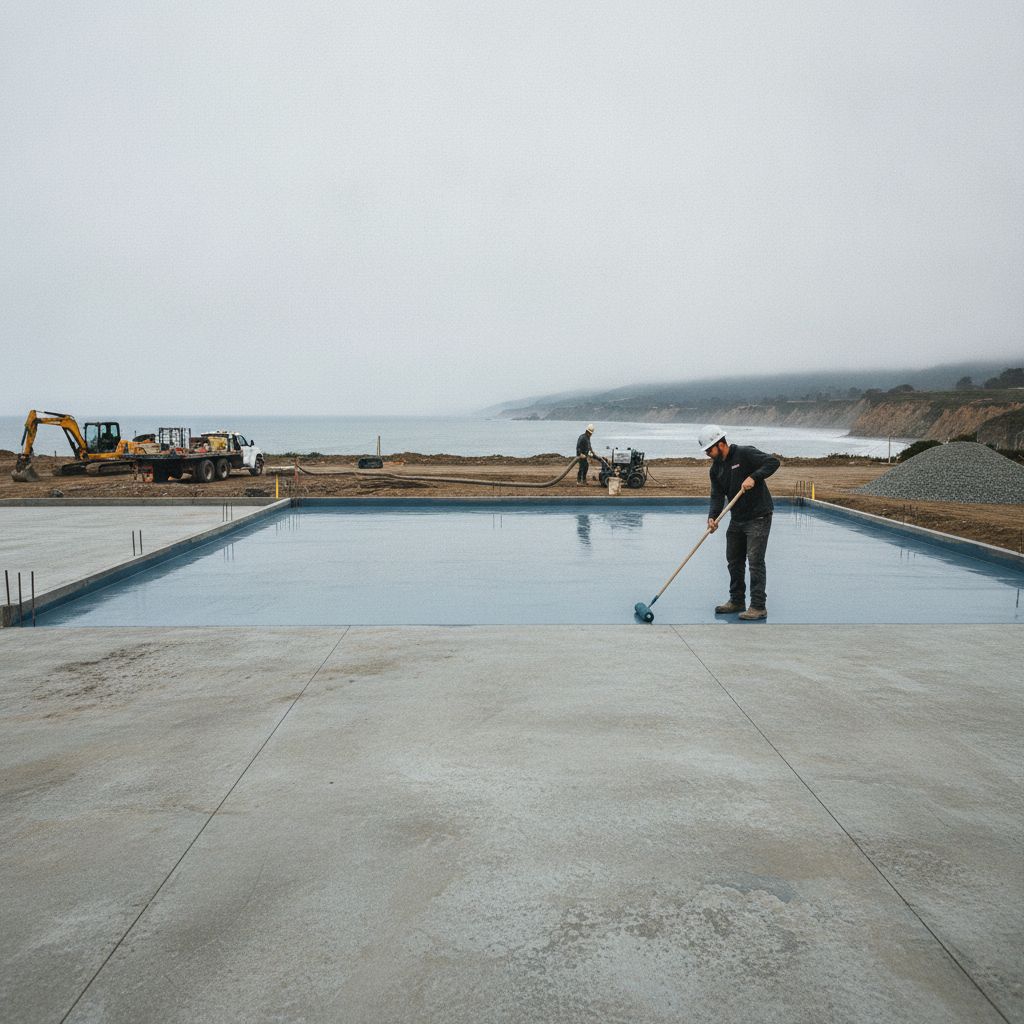
If you've had a coating blister, bubble, or peel within a year or two of installation in the Bay Area, moisture — not workmanship — is very often the actual cause. The region's persistent marine layer keeps ambient humidity elevated for much of the year, and slabs without a proper vapor barrier absorb and hold that moisture differently than slabs in drier inland climates.
Concrete is porous. In a low-humidity environment, moisture vapor moves through a slab and dissipates before it becomes a problem. In a marine-layer climate, that moisture has fewer opportunities to fully dissipate, and a coating applied without accounting for it can trap vapor at the bond line — the point where blistering and delamination start.
Before specifying a system for a coastal property, we run calcium chloride or relative-humidity slab testing to get an actual moisture-vapor-emission reading, rather than guessing based on the building's age or a visual inspection alone.
If testing comes back above the threshold for a standard system, we specify a vapor-barrier primer designed to block moisture transmission before the topcoat goes down — the difference between a coating that lasts and one that fails within a couple of seasons.
California Polyurea runs this testing as a standard part of every coastal California assessment — Bay Area, LA basin, and San Diego alike — so the system installed is actually built for the slab it's going on.
No obligation. We'll assess your space and give you a real number.